about Daniel Libeskind

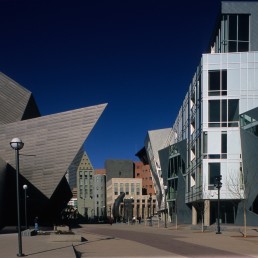
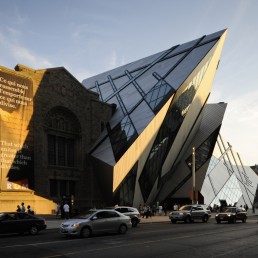
Denver Art Museum Residences
View Comments
Architect: Daniel Libeskind
Location: Denver
Tags: Denver Art Museum Residences
Posted September 30, 2011

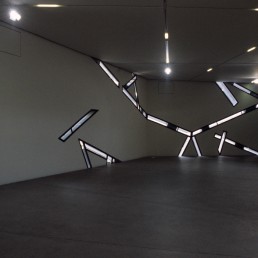
Jewish Museum Berlin (interior)
View Comments
Architect: Daniel Libeskind
Location: Berlin
Tags: Jewish Museum Berlin, Jüdisches Museum Berlin
Posted September 14, 2011

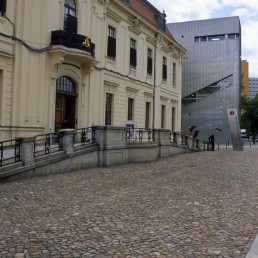
Jewish Museum Berlin (exterior)
View Comments
Architect: Daniel Libeskind
Location: Berlin
Tags: Jewish Museum Berlin, Jüdisches Museum Berlin
Posted September 14, 2011

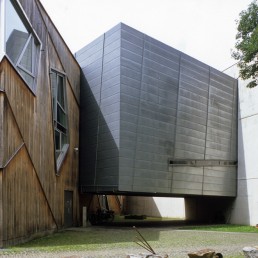
Felix Nussbaum House
View Comments
Architect: Daniel Libeskind
Location: Osnabrück
Tags: Felix Nussbaum Haus, Felix Nussbaum House
Posted September 8, 2011
Lecture 9.16.10 Intellectual and Artistic Expression
Podcast: Play in new window | Download
Three kinds of messages conveyed through architecture: a comparison of these messages in the Renaissance and in Modernism.
Order:
Villa Rotunda, Italy (Palladio)
Casa Rotunda, Switzerland (Stabio)
Bryn Mawr Dormitory, Penn. (Louis Kahn)
Complexity:
S. Carlo alla Quattro Fontane, Rome (Borromini)
Denver Museum of Art (Daniel Libeskind)
Technique:
S. Andrea, Italy (Alberti)
Schroeder House, Holland (Gerritt Rietveld)
Centre Pompideau, Paris (Piano and Rogers)
View Comments
Teaching Architecture and Society: lecture audio,Lectures
Architect: Borromini, Daniel Libeskind, Leon Battista Alberti, Louis I Kahn, Palladio, Renzo Piano
Posted September 19, 2010
Stararchitects
I was in a meeting the other day in which a pundit (not an architect) proclaimed that the era of stararchitects is over. The argument was that, in a more pared-down economy, the often “showy” work of stararchitects seems excessive and even decadent. The direction we should be going now is to really good design that is not so ego-driven or such a personal statement.
I have never been completely sure about the definition of “stararchitect”. I presume, at least in this context, that Daniel Libeskind and Zaha Hadid would be included but Peter Zumthor or Glenn Murcutt might not. If the comparison is made to movie “stars” versus just fine actors or actresses, then Tom Cruise and Angelina Jolie might be in the “star” category and Colin Firth or Judi Dench might just be a fine actor/actress. Being a “stararchitect” might have more to do with being a media darling or playing the fame game than with just doing wonderful buildings. Whatever you do–including your buildings–would need to garner a lot of attention. There would have to be a focus on the “star” and there would have to be a personal agenda.
If all of that is the case, then I am fine with an end to the stararchitect era. I think there has been some benefit to the kind of attention these architects have drawn to what we do. They have attracted media notice and have made anticipating their next new thing kind of fun. But there has also been a distraction from what architecture is really meant to do–make people’s lives better, create richer urban environments, help organizations accomplish their laudable missions, etc. The flash and pizazz has sometimes overpowered the meat of the matter. The cult of personality has sometimes dominated the actual building as a living breathing place apart from its author.
A movie full of “eye-candy” stars can be cool, but it does not compare to the kind of compelling drama that wraps you in its web and digs deep to your soul. An era of architecture that pays real attention to making stimulating, meaningful buildings for the people that inhabit them and cities that reflect the values and aspirations of their citizens might be a better focus for now than just making more “cool” things.
View Comments
Thinking about Contemporary Practices, Cultural Identity
Architect: Daniel Libeskind, Glenn Murcutt, Peter Zumthor, Zaha Hadid
Posted February 28, 2010