about Contemporary Practices


The Commune by the Great Wall

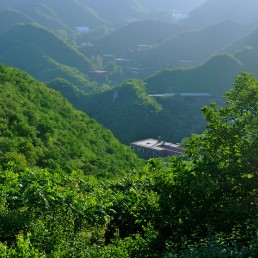
Nestled in the valleys of a beautiful site on the outskirts of Beijing is a group of contemporary houses and a clubhouse designed by 12 outstanding Asian architects.  Each house is an individualistic object and they bear little relationship to each other.  Although there are some nice moments in many of the houses, this project seems to be symptomatic of something wrong with architecture today.  These houses are less about site, human inhabitation and building a community than they are about each architect’s personal expression.  They all seem a little hollow and empty.

Furniture House by Shigeru Ban.

Bamboo Wall House by Kengo Kuma from Japan

The Shared House by Kanika R'kui from Thailand

Forest House by Nobuaki Furuya from Japan

Split House by Yung Ho Chang from China

Rammed earth wall in Split House

Suitcase House by Gary Chang from Hong Kong

See and Seen House by Cui Kai from China

Distorted Courtyard House by Rocco Yim from Hong Kong

Cantilever House by Antonio Ochoa from China

Airport House by Chien Hsueh-Yi from Taiwan

The Twins by Kay Ngee Tan from Singapore

The Clubhouse by Seung H-Sang from South Korea

View Comments
Thinking about Contemporary Practices
Posted August 14, 2010


Sendai Mediatheque

View Comments
Architect:
Location:
Thinking about Contemporary Practices, Cultural Identity
Tags:
Posted August 10, 2010


Museum of Modern Art

View Comments
Architect:
Location:
Thinking about Contemporary Practices
Tags:
Posted August 10, 2010


The Gallery of Horyuji Treasures

View Comments
Architect:
Location:
Thinking about Contemporary Practices, Cultural Identity
Tags:
Posted August 10, 2010


Marugame Genichiro-Inokuma Museum of Contemporary Art

View Comments
Architect:
Location:
Thinking about Contemporary Practices
Tags: ,
Posted August 10, 2010


Higashiyama Kaii Gallery

View Comments
Architect:
Location:
Thinking about Contemporary Practices
Tags:
Posted August 10, 2010


Morphosis in Shanghai

I had an incredible opportunity to see the new Giant Group Campus that is just being completed by Morphosis a short distance outside Shanghai.  Construction was pretty much finished, but the client had not moved in.  We were able to see the whole project quite thoroughly inside and out.

Many Morphosis projects make magic out of very tight constraints.  Caltrans is pinched by a limited budget.  The Cooper Union building seems to be trying to bust out of a straightjacket site.  But in this project in Shanghai there seem to be few constraints.  The 3-D sculptural quality that is evident in the models and drawings of many of the unrealized projects of Morphosis seem to be able to take full form here.

Land and water and buildings become one continuous experience.

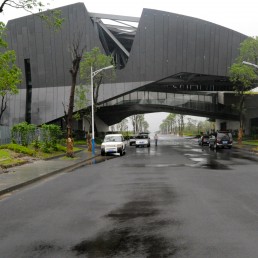
Building jumps over the road at the entry point.

Offices on east side of the campus are slung long and low around library and common spaces under a green roof.

Green roof reads as a rolling ground plane.

Office entry breaks down barriers between inside and outside with glass ceiling and bamboo-filled courtyard.

Interior of common spaces are spatially complex and dynamic.

Library space is sculpted from white planes and volumes and is lit from all sides.

Sensuous shapes are everywhere.

Actual work spaces are clean, orderly and beautifully lit.

East side entry sucks visitors down and into the building.

Hotel on west side of campus is tucked under a landscape form as well.

Entry to hotel introduces inverted, rounded conical forms.

The same conical forms act as landmarks in the fitness center.

Dramatic contrasts of light and dark animate the fitness center.

Indoor pool is a sensory delight.

Access to hotel rooms is from an outdoor passage.

The surface of the ground heaves up to become habitable. Earthen roofs reiterate the ground plane.  The building jumps over the road to create a broad sallyport.  It floats on or above the water surrounding it.  There is no clear separation between built and natural landscape.

The forms are aggressive and dynamic.  They thrust and jut and gesture dramatically.  The whole composition seems like a twisting, winding Chinese dragon.  It feels just right in its setting.

The larger campus is made up of two smaller ones–the eastern side housing offices, library and a suite for the CEO, the western side accommodating a fitness center and small hotel for corporate guest.  The two sides are connected by a bridge over the roadway that links the composition visually as well as functionally.

View Comments
Thinking about Buildings in Landscape, Contemporary Practices
Architect:
Location:
Posted July 10, 2010


Educatorium at the University of Uithof

View Comments
Architect:
Location:
Thinking about Campus Architecture, Contemporary Practices
Tags:
Posted May 17, 2010


Kanazawa Tamagawa Library

View Comments
Architect:
Location:
Thinking about Contemporary Practices
Tags:
Posted May 13, 2010


Naka Incineration Plant

View Comments
Architect:
Location:
Thinking about Contemporary Practices
Tags:
Posted May 13, 2010