about Cultural Identity


Yungang Caves–Architecture by Subtraction rather than Addition

I have long been fascinated by buildings created by carving out a void rather than by building a solid form.  I love the rock cut temple at Carli in India and the whole cities carved in the sides of the hills in Cappadocia in central Turkey.  But the very best version of this architecture  by subtraction may be the elaborate series of spaces created to house Buddhist figures near the border of Inner Mongolia.  There are over 51,000 statues here making it one of the most lavish expressions of Buddhist art in the world.  Some of the spaces are mammoth and some are tiny.  Almost all are articulated elaborately on every surface.  These structures were built 453-494 AD at the height of the period when Silk Road trade opened this area up to influences from Greece, Persia, Central Asia and India.

Dramatic scale and light inside.

Some of the more elaborate spaces have wooden temple facades outside.

Mammoth seated Buddha inside.Gateways mix wood and carved-out stone.

Thousands of tiny statues are carved out of some walls.

Much of the detail is still in beautiful condition and shows the uniqueness of each figure.

Soft light shows mottling of surfaces to best advantage.

The front of this space collapsed revealing the giant sculptures within.

Cave 18 is one of the most spectacular with its tall standing Buddha.

Buddha looms above once you are inside.

Sometimes the various spaces work together as an ensemble

Elaborate portals seem almost Egyptian in their scale.

View Comments
Thinking about Cultural Identity
Location:
Posted August 11, 2010


Sendai Mediatheque

View Comments
Architect:
Location:
Thinking about Contemporary Practices, Cultural Identity
Tags:
Posted August 10, 2010


The Gallery of Horyuji Treasures

View Comments
Architect:
Location:
Thinking about Contemporary Practices, Cultural Identity
Tags:
Posted August 10, 2010


Mu Ta Wooden Pagoda

It blows me away that this pagoda was built in the 11th century and was constructed with no nails.  It is one of the oldest wooden buildings in the world, and yet huge and magnificently ambitious.  It is in a small town between Taiyuan and Datong–just all by itself in an otherwise nondescript landscape.  The building actually leans slightly and there is concern about its eventual failure.  But, for now, it just seems remarkably ancient and resilient.

Wood joinery is impressive in so many traditional Chinese buildings.

Timbers are massive. You see very few trees currently in the landscape that could produce this size pieces.

The complexity of the joinery combined with the complexity of the polygonal geometry makes for some tricky intersections.

View Comments
Thinking about Cultural Identity
Location:
Posted August 3, 2010


Ancient Walled City of Pingyao

Surrounded by one of China’s few intact city walls, dating from 1370, Pingyao is a treasure trove of Ming and Qing architecture.  It was an affluent banking center beginning in the 15th century.  When the Qing dynasty defaulted on its loans and abdicated in the early 20th century the city’s economy collapsed and financial power moved to Shanghai and Hong Kong.  Pingyao became a backwater, but was saved from development and is one of the best preserved examples of traditional city fabric in the country.

Warning! really loved this place and got kind of carried away with the photography–so there are lots of pictures on this post.

Forty foot high walls that enclose the entire city.

NOrth Gate is one of six major entry points.

Delicate towers contrast sharply with fortified base.

Tops of walls are broad roads for moving around the periphery of the city.

Wood framing and bracketing in towers is as impressive as in temples.

South gate is even more foreboding than the north gate with huge blank walls.

Walls are mostly rectilinear, but this gentle curve near the south gate offers a remarkable counterpoint.

Sallyport through the wall into the city.

View from the top of the wall looking into the city.

Bell Tower spans over one of the city's major streets.

Other more minor streets have similar gateways.

Major streets are lined with very elaborate stone buildings.

Many of the old buildings are fully inhabited.

There is an elaborate pedestrian street scene in many areas.

Colorful make-shift shops abound.

There is a powerful contrast between the timeless old buildings and the ephemeral current inhabitation.

It's clear that this was once a very affluent place, but all of that glory is veiled in a patina of time.

Many buildings give the sense of protection and security natural to a banking center.

Though most buildings are stone, mud brick or rammed earth, wood is a common material as well.

Behind the street walls, most buildings are formed around courtyards.

Details in these interior environments are often lavish.

Residential and business uses were often mixed together around the courtyards.

Courtyards are filled with soft greenery and bright colors.

Interior rooms were small but sometimes beautifully appointed.

Some interiors are distinctly for business.

Business was also sometimes conducted from bed in residential quarters. These are mattresses placed on stone bases that kept temperatures more stable in a climate that can get very hot and very cold.

Harsh summer sun is nicely modulated by thick walls.

Traditional pedi-cab in "garage" off courtyard.

Contemporary versions of old rickshas are all over the streets today.

Pedaling a load of watermelons around would be really hard work.

In some parts of the city life on the streets is wonderfully lively.

Groups of guys hanging out is a national pass time in China.

Board games on the street are often a spectator sport.

Away from the main streets, the city is deteriorated and much quieter.

There are still signs of past glory.

But there is also poverty and neglect.

The courtyards are still the focus of life.

Outside of Pingyao to the south of the city is the Shuanglin Temple--also built around courtyards.

A kind of miniature version of the city, it has a series of portals that lead from court to court behind tall walls.

There is an austere beauty here you do not see in the restored Buddist temples in larger cities.

The wood is mostly unpainted and heavily weathered.

What color there is has been muted by time.

The traditional ornament is very powerful even without the normal polychrome surfaces.

Craft in the complex joints is more explicit than when covered by painted patterns.

As in the rest of Pingyao, time seems to have stood still over the last century.

This temple is particularly well known for its statures--like these guardians.

Many arms on a religious figure connotes great capability and power to do things.

View Comments
Thinking about Cultural Identity
Location:
Posted August 1, 2010


Chinese Open Air Markets

In the Muslim Quarter in Xian there is an amazing night market that is bustling with people, food and activity.  It is clearly the social heart of an ancient and cohesive neighborhood.  The street market weaves into a narrow bazaar that could be in Istanbul and finally up to the gates of the mosque.  What a visual feast!  And the people are a gas to watch.

At the peak of the market at 9:00pm or so the crowds are dense and represent every age group in the community.

Colorful and exuberant architecture is an appropriate framework for the market.

Permanent shops and restaurants mix with temporary stalls.

Pedi-cab stand at one end of the market to take people to and from.

A few people challenge the rules by bringing in bikes and motorcycles.

Landmark Drum Tower anchors one end of the market street.

Side street off of the main market leads to "turkish bazaar".

Displays are colorful and meticulously arranged.

The food on the main market street is the most luscious visual feast.

Sunflower seeds.

Pomegranites

Lots of mystery stuff.

Snake for dinner?

Rice cooked inside bamboo.

Supermarket in the middle of the open air market.

Full meals available on the street.

View Comments
Thinking about Cultural Identity
Location:
Posted July 31, 2010


Ming Dynasty Artifacts in Xian

Once the largest city in the world, Xian has been the capital of China for over 4000 years of its history.  There are artifacts from many periods of Chinese development.  In the central city, however, there are beautifully preserved relics that date back to the 14th and 15th century, the height of the Ming Dynasty.  The 9-mile long city walls are still intact and well preserved as are the Bell Tower, Drum Tower, the Great

Bell Tower

Drum Tower

Courtyard House in Muslim Quarter

Great Mosque--largest one in China. It is interesting to see this mix of Muslim religion and Chinese culture embodied in a single piece of architecture.

Mosque and several landmark homes.

View Comments
Thinking about Cultural Identity
Location:
Posted July 26, 2010


House of Culture

View Comments
Architect:
Location:
Thinking about Cultural Identity
Building
Posted July 26, 2010


Terra Cotta Warriors and Han Dynasty Tombs

Images of the Terra Cotta Warriors makes almost anyone want to travel to China.  Created over 2200 years ago and buried until a farmer discovered them in 1974, these vast excavations definitely live up to expectations.  The objects are beautiful.  The story of  a great leader preparing for protection in the afterlife for decades is mysterious and compelling.  The archeological feat underway is daunting.  Over 7000 soldiers have been unearthed, but many more remain underground.  Work is ongoing and visible to visitors.  The skill and creativity in the display of the material is impressive as well.

Half actual size bronze chariot made of 3600 pieces found near the burial mound of emperor Qin Shi Huangdi's tomb.

Detail of chariot.

Chariot's four horses.

Tomb of Liu Qi, fourth emperor of the Han Dynasty (206 BC-220 AD) on the other side of Xian from the Terra Cotta Warrior excavations.

Excavations of Liu Qi's tomb.

View Comments
Thinking about Cultural Identity
Location:
Posted July 25, 2010


Mountain Villages in Southern China

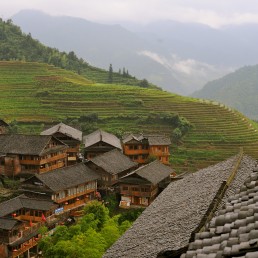
Although 92% of China’s population is the majority Han ethnicity there are a number of minority cultures that are often located in remote areas.  Some of these minority people live in beautiful Zhuang, Yao and Dong villages in the mountains of southern China where time seems to have stood still.  There are often no roads to these villages, and you must hike in an hour or more to get there.  The terrain is steep and dramatic, and the villages are nestled gracefully in to the mountainsides.  The farmers tend beautiful rice crops on terraces that have been in operation for generations.  Intricate irrigation systems feed the fields and create the constant sound of moving water.

The wooden houses here generally have a ground floor dedicated to stock, a middle floor for human habitation and a top floor for storing harvests.  The weathered wood and grey tile roofs make the buildings seems like they have just grown out of the soil of the mountain.

Flooded rice fields make swirling patterns accentuating the contours of the mountains.

Very labor intensive farming by hand.

Buildings and terraces are all generated by the contours of the landscape.

Stone entry gate on footpath to Zhuang village.

Wooden buildings are large, but dark and well integrated into the landscape.

Simple, sensible vernacular buildings.

Local forests are primary source of materials.

New construction follows longstanding patterns.

Different floors for different functions is articulated in the massing.

Slopes are steep and difficult for buildings to negotiate.

Bridge over irrigation channel.

A plaque in the bridge gave credit to all of the villagers who donated their time and resources to build it communally.

All transportation is via footpaths.

A few beasts of burden can negotiate the paths.

Mostly, humans are the beasts of burden.

Village life is slow and quiet.

Work is steady and constant.

There is a soft patina of age on everything.

Distinctive vertical stonework.

Emblem in paving that depicts the cooperation of three cultures--three fishes with one head.

View Comments
Thinking about Cultural Identity
Location:
Posted July 24, 2010