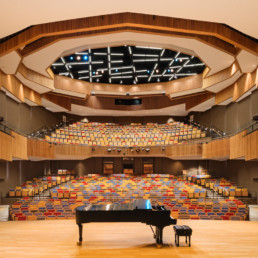
Performing Arts Center — University of Texas Rio Grande Valley
Architecture
The new Academic Performing Arts Complex replaces two existing 40-year-old buildings with a new facility and includes the renovation of two adjacent structures. The 94,000-square-foot complex will greatly enhance the performance and rehearsal assets of the university’s Music Department as well as the capabilities of the larger Rio Grande Valley arts community.The six primary spaces in the new…
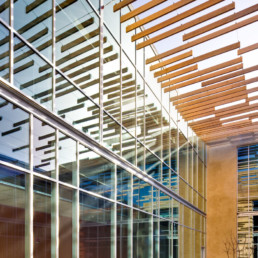
GSA Office Building
Architecture
Borrowing from the region’s indigenous architecture, the designers planned the two-story office building around a central courtyard. Double-height glazing on all four sides of the courtyard introduces daylight deep into the surrounding offices, public areas, and circulation routes. The courtyard is extensively shaded by a series of cable-supported transverse wood slats that are variably spaced to…
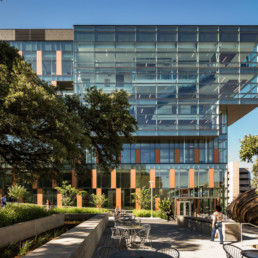
Dell Medical School — Health Learning Building
Architecture
The University of Texas at Austin is the first Tier One public university in the United States to build a new medical school from the ground up in almost 50 years and Page is an integral part of the effort. The campus is part of the master plan for a new medical district in Austin, which is being developed with an unprecedented community collaboration. The first phase of the Dell Medical School…
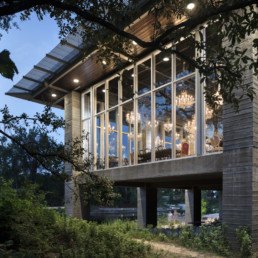
Buffalo Bayou Park
Architecture
Buffalo Bayou Park was undertaken by the Buffalo Bayou Partnership to transform the portion of the waterway which meanders east along Memorial Drive between Shepherd and Sabine Street in downtown Houston. Page is the architect for two buildings and two large pavilions in the 2.3-mile, 160-acre park, which was planned and designed by landscape architecture firm The SWA Group. The design of the…
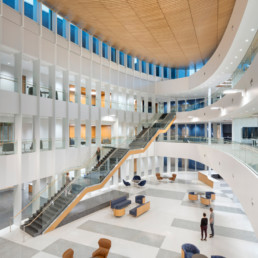
Brain Performance Institute
Architecture
The new Center for BrainHealth’s Brain Performance Institute, part of The University of Texas at Dallas, which opened in October 2017, is the first in the world to focus on leveraging scientifically validated programs and assessments in order to maximize and extend brain performance, increase brain resilience and improve brain regeneration for people of all ages and conditions. The…
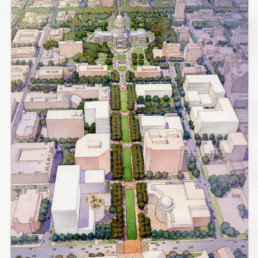
Austin Capitol Complex Master Plan
Architecture
The 2016 Texas Capitol Complex Master Plan provides for the creation of state office space and support facilities for short-term and long-term needs and establishes the Capitol Complex as a destination that celebrates the Texas State Capitol with civic spaces, shaded pedestrian friendly streets and connections to the surrounding community. The 40-block area encompassing the State Capitol Complex…
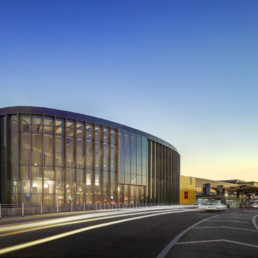
Austin Bergstrom International Airport Expansion
Architecture
Airline travel is being reinvented to focus on enhancing the passenger experience and the design of the ABIA Terminal East Infill Project accomplishes this. The project expanded existing passenger processing capabilities for security screening, ticketing, customs, and baggage handling in preparation for a nine-gate expansion of the East concourse of the Austin Bergstrom International Airport. The…

American Embassy Compound, Pakistan
Architecture
In 2001, Page began to pursue a new generation of design-build embassy projects offered by the U.S. Department of State’s Office of Overseas Building Operations (OBO). Since its first commission as the design partner for H.B. Zachary Co. on the New Embassy Compound (NEC) at Phnom Penh, Cambodia in 2002, Page has been a design partner on more than two dozen U.S. embassy and consular projects…
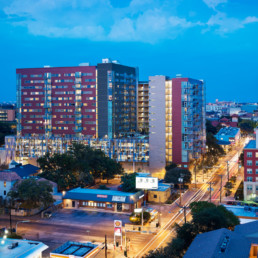
2400 Nueces — Student Housing
Architecture
The University of Texas has taken a giant step toward integrating student life with surrounding Austin neighborhoods through its new high-rise apartment in its West Campus. The residential project is designed to appeal to upperclassmen, graduates, faculty, staff and young professionals. Blurring the boundaries between “town” and “gown” is an important new trend in university living environments…

Chickasaw Nation Medical Center
Architecture
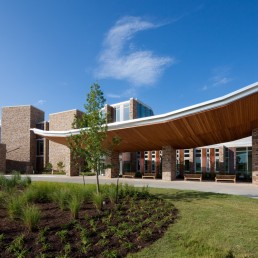
The Chickasaw Nation Medical Center connects with nature to provide a nurturing healthcare environment for Native Americans living in southeastern Oklahoma. The architecture maximizes access and views to the pristine, 230-acre site while inviting daylight into the buildings. Patient units are directly oriented to the creek and trees, with traditional hospital "front" and "back" elements tucked…
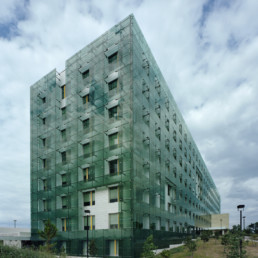
General Services Administration Field Office
Architecture
The FBI's recently opened 275,000-square-foot field office integrates concerns for security, sustainability, and appropriate image into a thoroughly synthesized design solution. A lightweight metal frame is hung from powerful concrete walls to carry a “second skin” for the building. Heavily fritted, laminated glass attaches to the lightweight frame with stainless steel clips. The almost opaque…
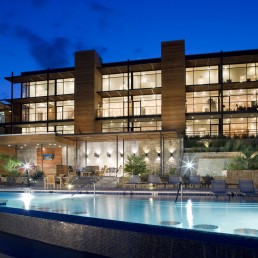
Waterstone Condominium Development
Architecture
Site characteristics and the desire to create an unusual merger of landscape and living drive the design of Waterstone, a collection of 71 condominiums on Lake Travis. Replacing a subdivision originally planned for low-density, single-family homes, the development inhabits the landscape with minimum intrusiveness while offering the privacy and convenience of single-family homes. The structures…
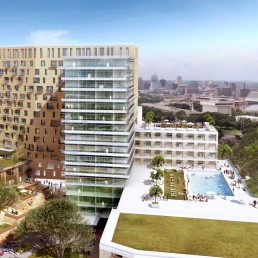
East Avenue Master Plan
Architecture
Master planning East Avenue, a 23-acre, mixed-use development, involved more than 80 meetings with stakeholders over the course of a year. The site, an ideal location for increasing density near Austin’s urban core, became available when a small college relocated. The East Avenue community will re-inhabit the site with moderate-income rental housing, condominiums, retail, medical offices, a…
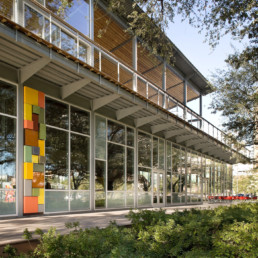
Discovery Green
Architecture
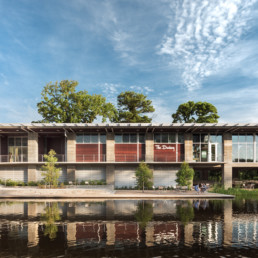
Discovery Green returns 12 acres of mostly paved lots to a natural green space in the heart of downtown Houston. A core of outdoor activity near the convention center, ballpark and arena, the park also provides a central focus for new development. Larry Speck led the design of the park's architecture, creating a model of sustainability. Two restaurants and a park administration building feature…
The Grove
Architecture
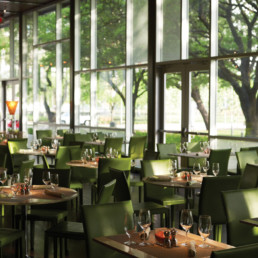
The Grove is set prominently within Discovery Green park, Houston's new 12-acre urban oasis. The restaurant architecture takes inspiration from a magnificent, double row of live oak trees that have long inhabited the site. Indoor and outdoor dining spaces are strung long and thin, just to the south of the oak alley. Each room has a slightly different vista into the tree canopy, through huge…
AMLI on 2nd Mixed-Use Development
Architecture
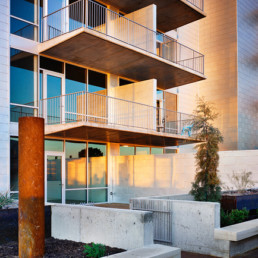
AMLI's first urban high-rise is a vital force in downtown Austin's rapidly developing 2nd Street Retail District. The 18-story, three-star-green building integrates 17 floors of apartments, 35,000 square feet of ground level retail, a spacious amenity deck and 4 1/2 levels of above-ground parking. The building image is contemporary, clean, and responsive to its urban context. Anodized aluminum…
U.S. Federal Courthouse
Architecture
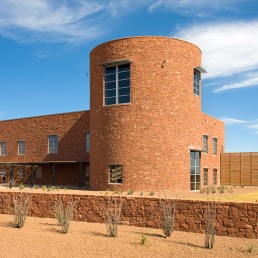
The Alpine Federal Courthouse is a simple, solid response to the extraordinary qualities of the local Texas landscape, the West Texas climate and the specific mission of its occupants. The powerful Trans-Pecos terrain dominates the experience of this locale. The building's materials―primarily russet-colored, dry-stacked West Texas sandstone―link the building to the larger landscape as well as…