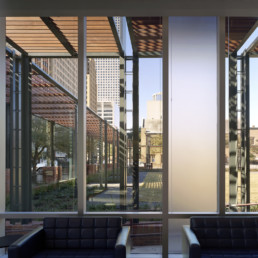
Mixed-Use Project for Christ Church Cathedral
Architecture
The expansion of the Christ Church Cathedral campus solidifies the congregation’s vision as the “church for downtown” while responding to its neighborhood. Four diverse program elements are carefully arranged on a full city block adjacent to the historic sanctuary. Central offices for the the Bishop and Diocese occupy an elegant, glass, two-story building enclosed in wood trellises. A…
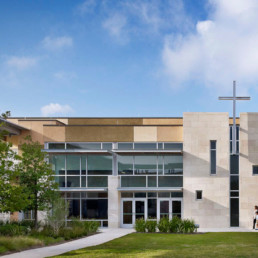
Trinity Episcopal School
Architecture
Trinity Episcopal School, a K-6 school, occupies a heavily wooded site in a densely developed, Austin commercial district. The master plan clusters individual buildings around a well-defined mall and plaza lined by two-story colonnades, allowing much of the beautiful site to remain a nature preserve. Building B, the first construction under the master plan, initiates the colonnade and anchors…
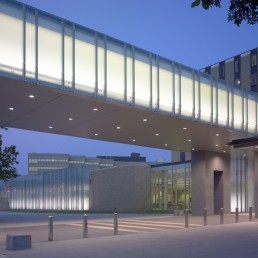
Seton Medical Center Expansion
Architecture
The expansion of Seton Medical Center creates a new “front door” image for a dated 1970s hospital, adding a day surgery, entry and chapel. Glass and light provide a sense of precision and technological sophistication alongside a certain softness and elusiveness--appropriate for a building where modern medicine deals with both scientific exactness and human frailty. A long volume faced with…
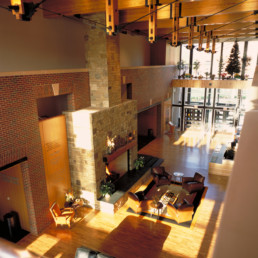
Oklahoma State University Alumni Center
Architecture
Positioned at the entry to the OSU campus, next to the university's most historic building, the new Alumni Center provides a welcoming hub for visiting alumni. While the brick exterior makes the building a good neighbor at the heart of a cohesive, red-brick campus, appropriate massing and scale help create a genuine sense of place. Broad arcades add a unique and active feature to the campus…
House on Turtle Creek
Architecture
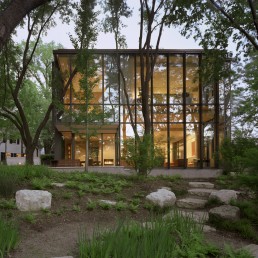
The House on Turtle Creek is a thorough renovation and addition to 1970s house originally designed by noted Dallas architect Bud Oglesby. The project became a kind of collaboration with Bud via the bones that he left for the house. Both ends of the structure, which were severely deteriorated, were removed; the house now opens up to extraordinary views of Turtle Creek and the Dallas Country Club.…
Austin City Lofts
Architecture
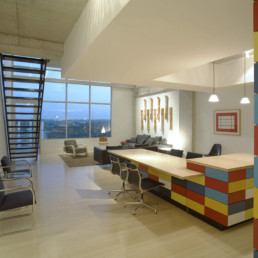
Austin City Lofts is an 82-unit, 14-story tower anchoring a new mixed-use district in the southwest quadrant of downtown Austin. Along busy 5th Street, a three-story horizontal stone volume houses the entry lobby, deep stacked porches and a modest retail strip off a shady arcade. Parking for 150 vehicles is tucked behind and below. A generous outdoor living area, including garden, pool and…
Computer Sciences Corporation
Architecture
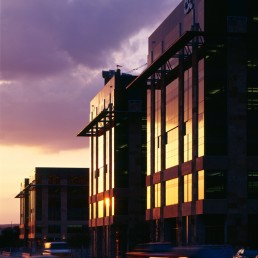
The twin CSC buildings on Lady Bird Lake in downtown Austin occupy a critical site in the revitalization of the city’s core. They emphasize the longstanding role of office buildings as “fabric” in the urban environment and draw their architectural character from urban design goals. The buildings each encompass 350,000 square feet, creating an appropriately scaled edge to the lake and parkland,…
Driscoll Children’s Hospital Pediatric Sub-Specialty Clinics
Architecture
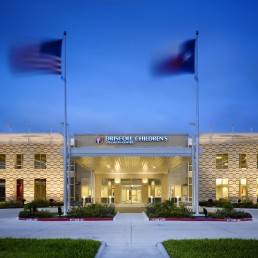
Two new signature pediatric facilities in Texas' Rio Grande Valley reinforce the Driscoll Children's Hospital brand while embracing the culture of their communities. Each features a colorful, porch element that is easy to identify and open to the street. The main circulation system extends the inviting facade with waiting areas and playscapes for children. Clinical zones are organized in…
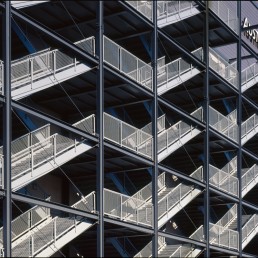
Austin Convention Center Expansion
Architecture
In the Austin Convention Center's 400,000-square-foot expansion, reception halls, meeting rooms, pre-function spaces and circulation towers are expressed as individual elements joined by entries, porches and terraces. The design creates an appropriate scale along pedestrian-oriented street, with larger volumes of the exhibition halls and ballrooms tucked behind. The various concourses culminate…
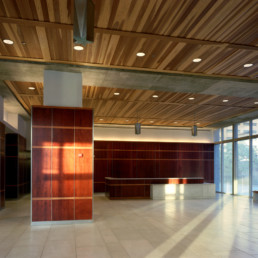
Robert E. Johnson Legislative Office Building
Architecture
Located in the shadows of the Texas State Capitol building in central Austin, the Robert E. Johnson Legislative Office Building stands as a symbol of contemporary state government and the agencies that inhabit it. The design creates a dignified but accessible place, emblematic of open, participatory government and welcoming to constituents and the general public. Conceived as a sustainability…
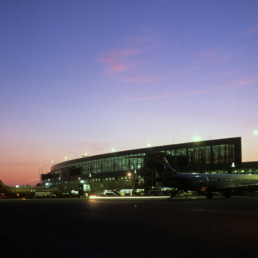
Austin Bergstrom International Airport
Architecture
Local materials and iconography, a sense of openness, and a relaxed, informal character embrace Austin’s unique culture and heritage at the Barbara Jordan Passenger Terminal. The crescent-shaped terminal organization is simple and direct, providing easy orientation and minimal walking distance from curbside to gate. The plan maximizes visibility for concessions by creating a large central…
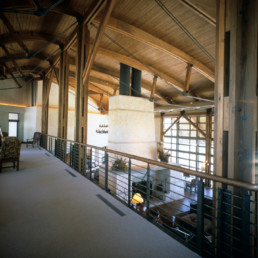
Rough Creek Lodge
Architecture
Positioned on a high ridge with commanding views of a lake, mature live oaks and the rounded peak of Chalk Mountain, Rough Creek Lodge is the focus of an 11,000-acre ranch in the Texas Hill Country. The buildings sit long and low, hugging the contours of the hill and nestling into existing trees to form a continuous mass of natural and manmade forms that rim the brow of the promontory. Public…
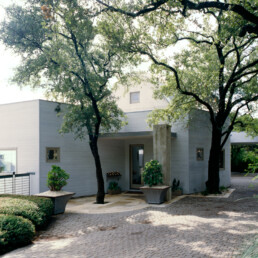
Concrete House
Architecture
Poor soil conditions on a spectacular site required a heroic foundation with few drilled piers and deep foundation beams. This, combined with the steep slope, gorgeous views, and abundant existing trees, dictated a long, thin rectangular footprint and a simple concrete volume to span between the piers. All of the major rooms, which look out to the trees or above them to downtown Austin, are…
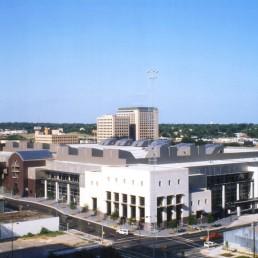
Austin Convention Center
Architecture
The Austin Convention Center integrates harmoniously into the fabric of the city. Building circulation and smaller-scaled programmatic elements surround the large exhibition spaces, enlivening the streetscape. Lobbies, meeting rooms and pre-function spaces are designed individually with scale, proportion, color, material and character representative of the city and region. Green design figures…
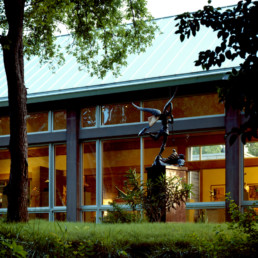
Umlauf Sculpture Garden & Museum
Architecture
Umlauf Sculpture Garden features the work of American sculptor Charles Umlauf in a naturally landscaped garden at the edge of Zilker Park. Larry Speck designed the museum and visitors center, which contribute to a beloved, public gathering space in the heart of Austin. The building expression is quiet and understated. A long, thin, stone structure houses visitor support functions, creating a…
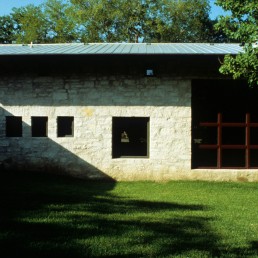
House on Sunny Slope
Architecture
The House on Sunny Slope is designed for informal family living, commissioned by a single father with two young sons. The primary yard is placed in the front, surrounded by a wall, to maximize private outdoor space on a small lot. The carport doubles as an outdoor game room/entertainment space, strongly oriented to the yard. Inside, a dominant room with 18-inch exposed stone walls houses…
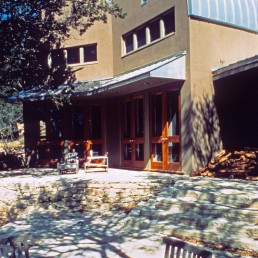
Wimberley Ranch House
Architecture
The Wimberley Ranch House is positioned atop a bluff above the Blanco River on a large cattle and horse ranch. In the tradition of Texas ranch buildings, the design is an aggregation of individual elements that are freely adapted to their function and location. Independent forms are loosely collected around an existing, bowl-shaped draw, which directs views up and down the river and to the…
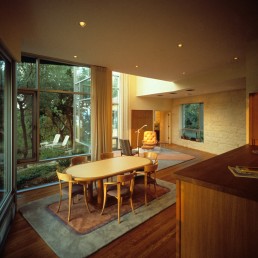
Lake Travis House
Architecture
The Lake Travis House is perched on a 100-foot bluff with extraordinary views to the southwest, west and north. The home's west side takes the form of a sweeping arc, acknowledging the panorama; wall shapes and windows are oriented to match specific vistas. The home's design responds to specific functional preferences for the family of four. On the lower floor, playroom, living room, dining…
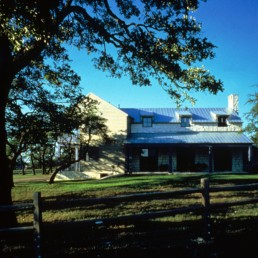
Burnet Ranch House
Architecture
The Burnet Ranch House rests on the dominant ridge of a small cattle and goat ranch in Central Texas. The clients, a family of four who live on the ranch full-time, required typical house functions as well a special acknowledgment of their rural lifestyle. Consistent with regional traditions, the home is broken into five small building elements, aggregated in response to site and function.…
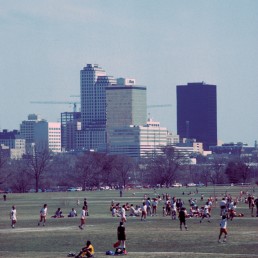
Town Lake Comprehensive Plan
Architecture
When it was completed in 1984, the Town Lake Comprehensive Plan was the largest planning project ever undertaken by the City of Austin. Its purpose was to consolidate park lands and useful recreation space through selective land acquisitions, thereby creating an active new “living room” for the heart of the city. The plan also located future civic functions and performance venues and outlined…